Organized for Excellence
Most community health centers are doing important work under real pressure reasonably well.
A select few are doing this work with consistent excellence.
The difference is rarely resources.
It's organizational habits.
How Ordinary People Achieve Extraordinary Results
in Community Health Centers
What Community Health Center Excellence Looks Like
“Excellence” denotes the fullest realization of what something is capable of becoming. A knife that cuts well is excellent as a knife. A physician who diagnoses well, treats with skill, and cares for patients as whole persons is excellent as a physician. A Community Health Center that cares for and supports its employees and volunteers, delivers superb health care to patients, engages deeply with its community, is fiscally sound, and continuously improves is excellent as an organization.
Flourishing Employees
All employees feel that they belong to and are part of a community. They feel accepted, affirmed, and respected.
All employees have a strong sense of purpose and derive meaning from helping to serve patients who would otherwise go without care.
All employees have a coherent, logically compelling, and meaningful understanding of the Center’s mission and its work.
All employees are able to develop their knowledge and skills and to deploy them in ways that make a visible difference to patients and colleagues alike.
All employees have genuine autonomy in the performance of their work, exercised within clinical protocols, professional standards, and the center’s stated values. The organization ensures that workloads allow that autonomy to be exercised with care.
No employee suffers preventable harm: zero lost workdays for job-related injuries or illnesses and zero cases of work-induced illness.
The center achieves sustainable workloads, provides adequate resources, reduces administrative burdens, and actively attends to workforce wellbeing, with zero preventable burnout among all employees as the measure of success.
The center creates an environment of psychological safety in which every employee can speak up or ask questions without fear of embarrassment, shaming, or judgment.
The center compensates each employee with sufficient income to live with dignity in the community, meeting or exceeding local compensation standards.
Both the Center and colleagues give employees immediate, specific, informal, and personal recognition and gratitude for their contributions to the success of the whole.
Deep Community Engagement
The Center genuinely represents the people it serves in the community— including people experiencing poverty, unhoused individuals, people whose primary language is not English, and people managing chronic illness without reliable support.
The Center understands that its patients’ health problems are often produced or worsened by conditions that no amount of clinical skill can cure: income and economic insecurity, housing instability, limited access to nutritious food, inadequate education, unsafe neighborhoods, and weak social connections.
The Center screens patients for unmet social needs, maintains working relationships with housing agencies, food banks, schools, employers, social service organizations, and local government, and participates in community coalitions that address these upstream conditions.
The Center functions as an anchor institution of the community — knowledgeable, active, and principled — whose concern extends from the examination room to the school board, the affordable housing discussion, and the policy conversation about food access. Where it can, it acts. It partners where it cannot act alone. And it advocates where only policy can produce the change that health requires.
Community Health Center Excellence has four main components:
Flourishing Employees
Optimal Patient Outcomes
Deep Community Engagement
Fiscal Health and Stewardship
Each is described more fully below.
Optimal Patient Outcomes
Every patient— insured or uninsured, housed or unhoused, regardless of income, background, or how many times they have been turned away elsewhere — is received and treated as a person of full worth and dignity. Employees listen with genuine attention and respond with empathy for what the patient is experiencing.
Patients are seen as whole persons within the context of their families, caregivers, work, and communities. This understanding shapes their care, not just the clinician's attitude.
Patients are active participants in decisions about their own care. Clinicians present diagnoses, treatment options, and the risks and benefits of each in plain language, ensure the patient understands, and respect the patient's informed choices.
Every patient receives care in a language and at a literacy level they can understand. Communication is adapted to the patient's health literacy.
Patients experience zero preventable physical harm as a result of their interaction with the center and its employees, and zero preventable misdiagnoses and inaccurate prescriptions.
The center does not wait for patients to return with worsening conditions. For patients managing chronic illness, the center proactively coordinates follow-up and continuity with a known provider who understands the patient’s history.
Patient records are complete and accurate — including the patient's preferences, concerns, and social context — and form a reliable basis for good care by other professionals.
Patients are referred to specialists with complete and accurate referral notes that convey the patient as a whole person, and that the treating professional follows up with the specialist to confirm effective treatment.
Fiscal Health & Stewardship
The Center maintains the financial health necessary to fulfill its mission reliably and over time, with sufficient revenues to cover its expenses, substantial reserves to absorb fluctuations in funding, and access to the resources needed for investments in people, technology, and infrastructure that sustaining excellence demands.
Resources are gathered, managed, and deployed in service of the Center’s mission, and the mission is the standard against which financial decisions are judged.
The Center exercises responsible stewardship of the public and philanthropic resources entrusted to it, using them with integrity and transparency and for the intended purposes. Financial reporting is accurate and timely. Conflicts of interest are identified and managed.
The Center plans for its financial future with the same rigor it applies to clinical quality and community engagement. It understands its cost structure. It monitors the policy and regulatory environment that shapes its revenue. It makes capital investments deliberately, with a clear understanding of how they serve the mission. And it builds the financial resilience — in reserves, in revenue diversification, in relationships with funders and policymakers — to remain a reliable presence in its community through the inevitable cycles of constraint and opportunity.
The Gap Between Good Intentions & Excellence
Leading a community health center is among the most demanding challenges in American healthcare. You are asked to deliver high-quality primary care to vulnerable populations, under chronic resource constraints, inside a regulatory environment that never stops changing — while managing a workforce stressed by burnout within a resource-strapped organization continually teetering on the edge of insolvency.
While most CHCs meet that challenge well enough to survive, they are also plagued with
clinician shortages,
recruiting problems,
a lack of funds, and
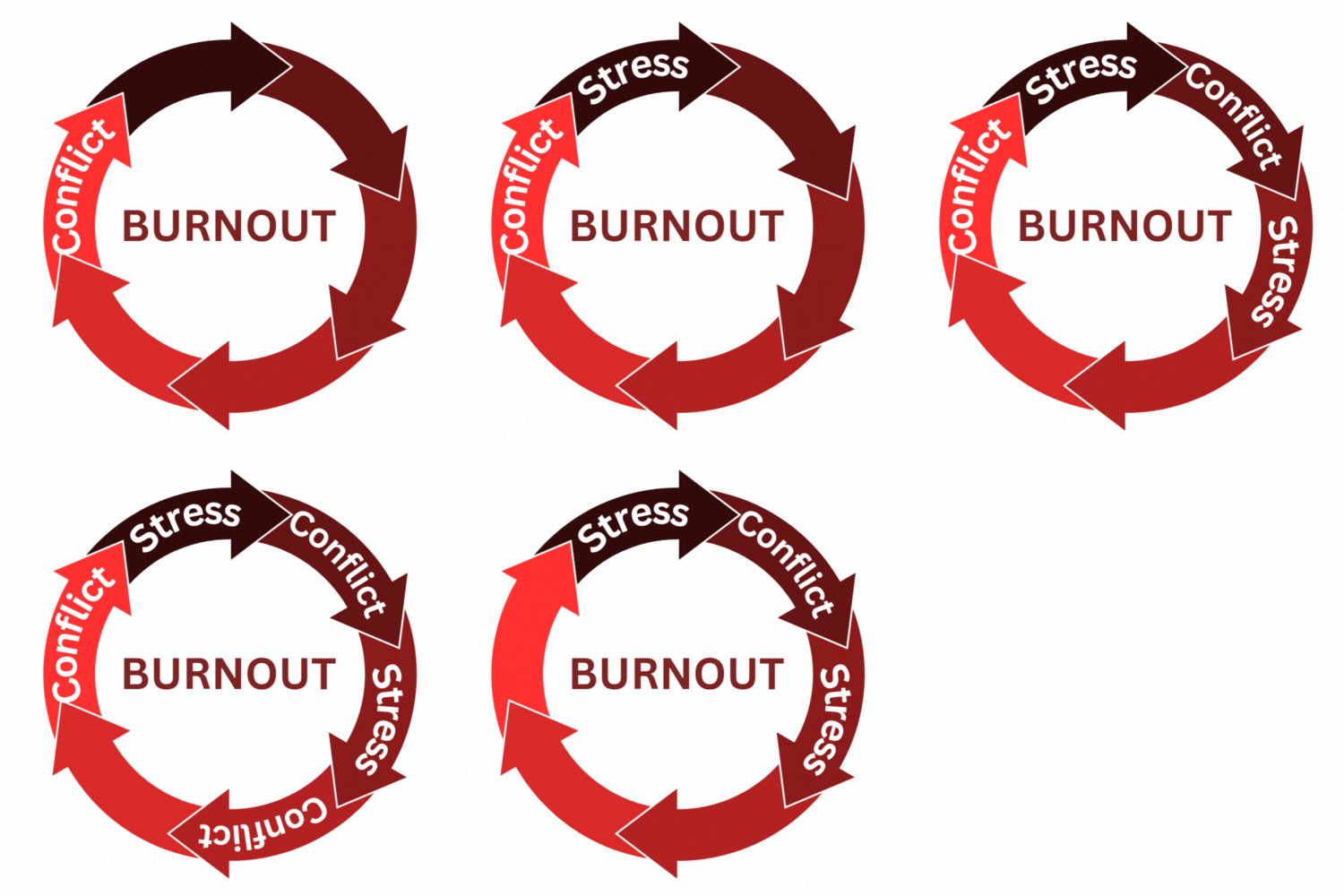
clinician burnout and turnover.

How Can We Solve These Problems?
It’s tempting to assume that the answer is money, staffing, or geography.
More often, the real barriers are organizational:
A board that checks compliance boxes but is not strategically engaged
Management habits that react to problems rather than prevent them
Staffing and scheduling practices that lead to clinician burnout
Persistent turnover that drains institutional knowledge
Mission drift that obscures the purpose of the center
None of these are failures of character or commitment.
They are the predictable result of the failure to design for habitual excellence and the lack of a practical framework for getting there.
Organized for Excellence provides that framework.
“You never change things by fighting the existing reality. To change something, build a new model that makes the existing model obsolete.”
Buckminster Fuller
How to Get There
The 9 Conditions of Community Health Center Excellence
Excellent community health centers are not mysterious. They share a recognizable character — a set of organizational conditions that, taken together, produce flourishing employees, exceptional patient care, and the kind of community trust that sustains a center through difficult times.
These conditions are not natural gifts. They are the result of deliberate organizational design — built, maintained, and continually improved by leaders who understand what they are trying to build and why.
Clarity of Purpose
Knowledge, Competence, and Good Judgment
Flourishing Employees
Best Outcomes for Patients
Engagement with the Community
Strategic Governance & Leadership
Fiscal Health & Stewardship
Honest Self-Assessment
Continual Learning & Improvement
It Begins with the Board
The board of a community health center holds the mission in trust. It sets the standards for strategic thinking, financial stewardship, and organizational accountability. It governs on behalf of the community — including the patients who hold the majority of its seats.
We created the CHC Board Training Program to help boards acquire the knowledge, methods, and skills for fulfilling these responsibilities well.

“Great people inside a flawed system will always underperform those in a great system.”
Dave Chase, Health Rosetta